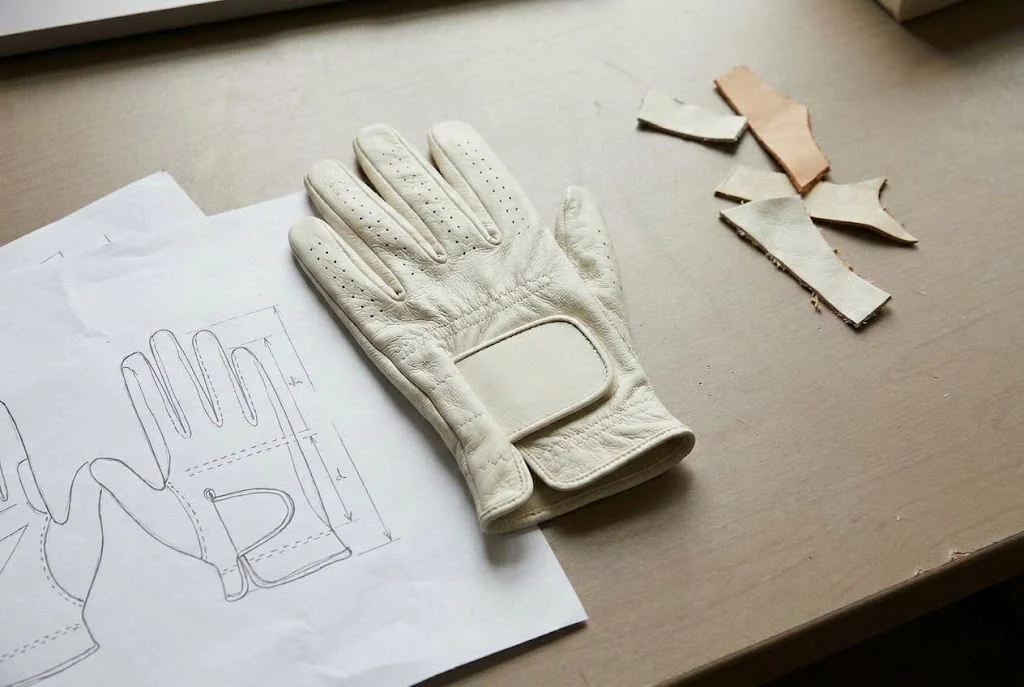
Selling the same golf glove in more than one language starts with agreeing what the product actually is. Keep an approved record of its materials, fit, wearing hand, supplied quantity and care guidance, then translate from that reference. A fluent description is useful only when it still describes the glove the customer will receive.
Start with the approved glove, not last season's copy
Before commissioning a translation, identify the approved sample, specification and artwork version. If the palm material changed during development, an old English description can carry that mistake into every later language. Translation makes consistent information more widely useful; it can also spread an unresolved error.
At Texpak, physical samples are sent for approval and a master sample is retained for production comparison. Use that reference alongside the written specification when building your product record. Our tech-pack checklist explains the manufacturing brief; the task here is keeping that agreed information consistent when other people translate or publish it.
Give each product record an owner and revision date. Identify the source language, the language being prepared and the markets in which that version will be used. Spanish, for example, is a language choice; it does not automatically settle destination-specific commercial or labelling requirements.
Create a short terminology sheet
Ask the writer and translator to agree a small glossary before translating a whole collection. Include material names, fit cuts, wearing-hand descriptions, the supplied unit and the names of components that matter to your product. A familiar English abbreviation may become ambiguous when copied into another language.
| Information | What must remain clear |
|---|---|
| Panel materials | Which parts are Cabretta, synthetic leather, synthetic suede or another confirmed material. |
| Wearing hand | The hand that wears the glove, separately from the golfer's playing side. |
| Fit cut and size | The approved pattern reference and size label, with clearly labelled measurements. |
| Supplied quantity | One individual glove, a pair or a defined set. |
| Care and claims | Instructions and statements supported by the complete construction. |
| Commercial information | Who maintains prices, availability, delivery and customer support for that market. |
For a mixed-material example, a Cabretta palm with a synthetic back should stay a mixed-material glove in every version. A translator should not simplify that into an all-leather claim merely because the shorter phrase sounds more natural.
Translate the wearing hand and fit carefully
Describe the hand the glove is worn on explicitly. The Spanish phrase “se lleva en la mano izquierda”, for example, describes left-hand wear. It does not describe a golfer's swing direction. Keep the order sheet, packaging and product page aligned on that distinction.
A size letter should also remain tied to the approved pattern. Do not create a national conversion chart by assuming every medium has the same measurements. Texpak uses regional starting patterns and can adapt them for a brand, with physical samples reviewed before production.
If measurements need conversion, retain the controlling specification and label the units. Agree how measurements are taken before comparing numbers. Our fit guide and assortment guide cover the underlying product decisions.
Review care guidance and performance language separately
Have care wording checked against the finished glove, including decoration and trims. An instruction that suits a plain leather sample may not describe the construction finally approved. Keep the approved instruction with its product version so it can be translated consistently.
Make a separate list of claims requiring evidence. A phrase describing a perforated panel should not become a guarantee that every hand will stay dry. A soft feel should not become a measured performance improvement. Ask a reviewer to compare the meaning, not just the spelling.
Our care guide and quality-control guide help distinguish construction, care and checks. Do not add a test standard or certification that the product record does not support.
Check the translated text in the finished layout
A translation can take more space than the source wording. Review the actual package proof and product page at their intended size. Check that the wearing hand, size and supplied unit remain easy to find, and that a long material description is not cut off on a phone.
Supply the translator with useful context: palm and back photographs, an annotated specification and the purpose of each field. A short label beside a size selector needs different wording from a paragraph explaining material choices.
For wholesale partners, keep the same approved product references across language versions. The descriptions can change language while the variant identities remain traceable. Our wholesale line-sheet guide covers the buying document a stockist needs.
Give each website translation a clear destination
For a website, use a maintained page for each language and provide a visible way to switch between equivalent versions. Google's multilingual-site guidance recommends separate language URLs and clear language choices. Translate the useful main content, not just the menu around an English article.
Keep the page title, description, image descriptions and body consistent with that language. Check links too: if the next step is an English-only contact page, say so rather than implying a Spanish-speaking sales team is available. Texpak's sales communication is in English.
Update every affected version when the glove changes
Keep a change log connecting each language version to the approved product record. When the specification changes, flag the affected text, images, labels and retail documents. Do not let one market's corrected copy sit beside another market's obsolete description.
A useful final check is to ask someone who did not prepare the original copy to identify the material, wearing hand, size, supplied quantity and care instructions from the translated version alone. Compare the answers with the approved record.
If you are developing the glove behind those descriptions, share the product brief and target markets with Texpak. We can discuss materials, patterns, artwork, packaging and physical samples. Translation should carry a clear specification into another language; it cannot approve an unresolved product.