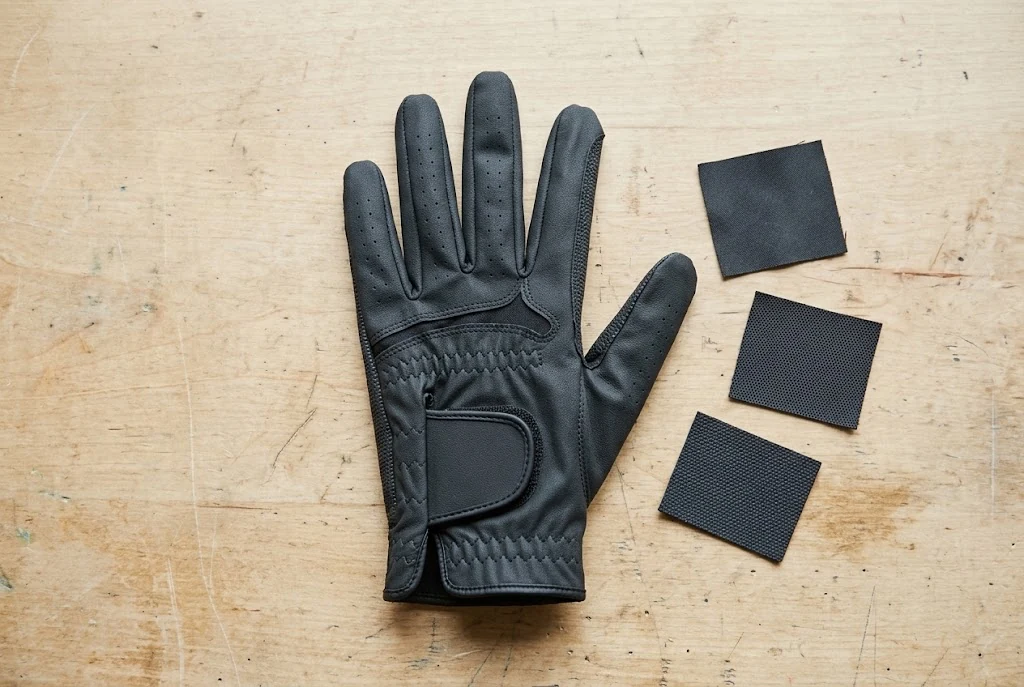
When developing a golf glove with stretch inserts, identify the insert material and position, then assess the finished glove with an open hand and a natural grip. Review the joined areas as well as the insert itself. A visible stretch panel does not establish a universal fit or a measured performance gain.
Give the insert a specific role in the brief
At Texpak, the team describes stretch inserts as moving further than leather and helping provide a secure fit. That manufacturing experience is a useful starting point for development. It is not a published stretch percentage or a promise that one construction will fit every hand.
Decide what you want to evaluate. A brand may be exploring how a section moves during gripping, how a panel transition feels or how the proposed construction sits within the intended fit. Put that question beside the drawing so appearance does not become the only approval criterion.
Use the hybrid construction guide to identify the surrounding materials. “Stretch” describes a feature to investigate; it does not name the actual component or the whole glove specification.
Map placement and the neighbouring construction
Show the insert boundary, the adjacent panels and the relevant seam positions. Keep the sample size, wearing hand and pattern reference on the same sheet. Ask the manufacturer which parts of your proposed layout are practical and which still need development.
Do not specify a fiber, proprietary material name or exact elasticity merely because it appears in a reference product. Record the actual component proposed for your sample and the information available about it. A generic photograph cannot establish those facts.
The insert and the pattern need to be considered together. An attempt to add movement in one area can leave an unresolved fit concern elsewhere. Our fit guide gives the wider palm, finger, thumb and closure checks to keep in view.
Use consistent positions for sample observations
Begin with careful donning and natural fastening. Look at the glove with the hand open, then close around a familiar club grip without deliberately overstretching it. Record what happens in the intended use position. Pulling a loose swatch by hand is a different observation from wearing the assembled glove.
| View or action | Useful observation | Reference to retain |
|---|---|---|
| Open hand | Insert location and how the surrounding panels sit. | Full-hand view and sample identifier. |
| Natural grip | Movement, gathering or a transition the reviewer notices. | Same grip position for each revision. |
| Closure fastened | Whether the whole fit remains as intended. | Size, hand and pattern version. |
| Careful removal | Any particular awkward contact or opening issue. | Location-specific note rather than a general verdict. |
These are suggested development observations, not a mechanical test method. If your brand needs a measured property or a particular test result, raise that as a separate requirement in the quality-control discussion.
Change one identified detail where practical
A comparison is easier to interpret when the team knows what changed. If you revise the insert position, palm material and finger lengths at the same time, improved feedback cannot be confidently assigned to a single alteration. Sometimes several changes are necessary, but record them rather than describing the samples as identical apart from the insert.
For a fictional example, a reviewer may like the overall movement but notice a transition beside one finger while gripping. Mark that location and ask what practical revision could address it. Do not turn a local observation into an instruction to stretch every dimension of the pattern.
Use the sample-revision checklist to consolidate the accepted details and open insert questions.
Approve the construction, then describe it accurately
Agree suitable review coverage across the intended range. Keep the accepted insert reference and placement with the approved glove and specification.
Retail wording should describe the feature you have confirmed. Avoid adding unmeasured claims about extra durability, improved scores or a percentage of stretch. The separate break-in guide explains why leather shaping and stretch-panel movement should not be treated as the same thing.
Send Texpak your intended fit and insert-placement ideas. The team can discuss practical material and pattern options through physical sample development, with the final construction agreed for your project.