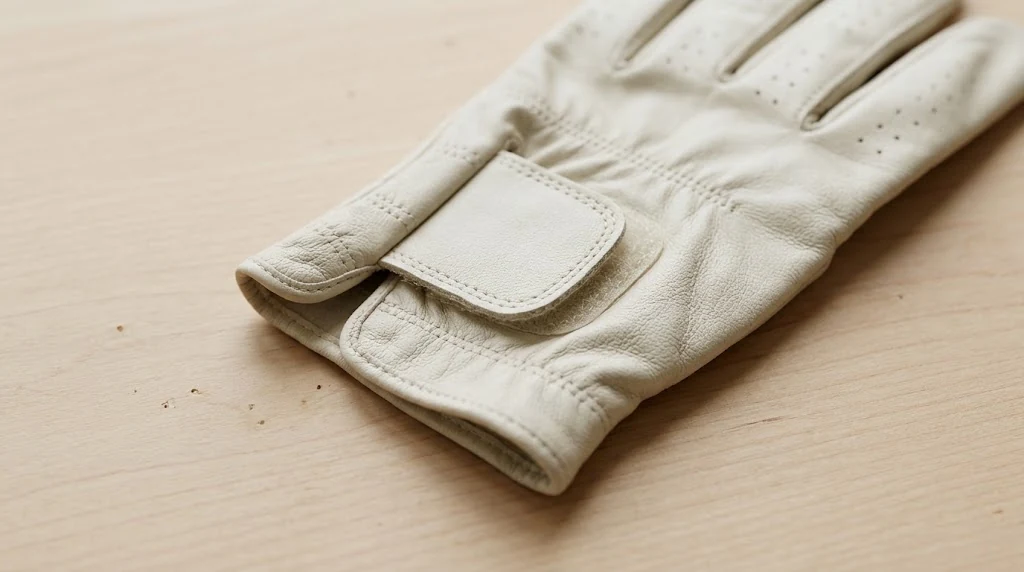
Review a golf glove closure with the glove worn and the hand holding a familiar grip. Check where the strap reaches, how naturally it fastens and whether its edges or position create a distraction. A neat logo on an empty glove cannot establish those details.
Define what the closure needs to do
Start with the wearer and the whole pattern. A strap should help secure the intended glove; it should not be asked to rescue a palm that is too wide, fingers that are too short or the wrong fit range. If the sample only feels acceptable when the fastening is pulled unusually hard, record the fit concern before proposing a longer strap.
Our golf glove fit guide covers the wider palm, finger and thumb checks. For closure development, keep the size, wearing hand, material and pattern revision visible. Otherwise, two closures may appear different when the main change was the glove underneath them.
Write the desired outcome in plain language: easy to locate, comfortable to fasten and suitable for the agreed appearance. Avoid starting with an unsupported promise such as a universal fit or a specific fastening lifespan.
Review it in more than one hand position
Put the sample on without forcing the fingers. Fasten the strap naturally, then open the hand and hold a club grip. Notice the strap's position in each view. Does it lie as intended? Is an edge noticeable? Does the glove move elsewhere when it closes?
FootJoy's fitting guidance includes leaving closure adjustment available in its own designs. That is a useful reminder to assess adjustment, not a dimensional rule for every custom strap. Agree the intended position for your actual pattern instead of copying another brand's percentage or overlap.
Check opening as well as closing. Ask a reviewer to remove the glove carefully using the intended opening, then describe any awkward step. Record the observation rather than repeatedly pulling an edge to prove a point. An informal sample review does not establish a measured cycle-life result.
Make the feedback specific enough to use
A marked photograph and a short note are more useful than “the strap feels wrong”. Use the same camera views for the original and proposed revision. Keep a wider view of the whole glove so the manufacturing team can place the close-up in context.
| Review area | Observation to record | Question for the sample team |
|---|---|---|
| Reach and position | Where the tab lands with natural fastening. | Is the issue placement, strap shape or the underlying fit? |
| Adjustment | Whether the intended wearer has useful adjustment. | What position should this pattern provide? |
| Edges and contact | The exact location noticed while gripping. | Which construction detail could be reviewed? |
| Opening | Any awkward movement during careful removal. | Does the revised opening still support the intended fit? |
| Appearance | Artwork orientation on the fastened glove. | Does the approved layout work on this actual size? |
This is a suggested buyer record, not a factory test standard. At Texpak, measurements, marked photographs and physical references help the team understand a requested change. The sample-revision guide explains how to consolidate that feedback.
Check the intended range and the finished branding
A closure reviewed on one medium sample does not establish how every size will feel. Agree suitable review coverage for the sizes and wearing hands you plan to offer. Do not assume that a change in strap artwork and a change in strap construction are the same approval.
Look at the logo with the glove fastened, not only laid flat. Its angle, scale and available space may read differently on a worn hand. Keep technical file and print decisions in the artwork approval record; the closure review should identify which version was actually assessed.
For a fictional example, a brand may like its sample's fastening feel but find that the logo turns away from the intended viewing position. Record the appearance concern while retaining the accepted fit observations. Ask what revision is practical, then assess the revised glove rather than assuming an artwork move leaves every other detail unaffected.
Approve the identified construction
Record the accepted strap construction and artwork with the approved sample. If its material, shape or position changes, ask what must be reviewed again.
Our quality-control guide covers the separate manufacturing-check discussion. If you need a particular fastening test or supporting record, raise that requirement explicitly rather than assuming that a general sample approval supplies it.
Share your closure ideas and glove brief with Texpak. Include your intended fit, size range and the detail you want to resolve, so the team can discuss a practical physical sample.