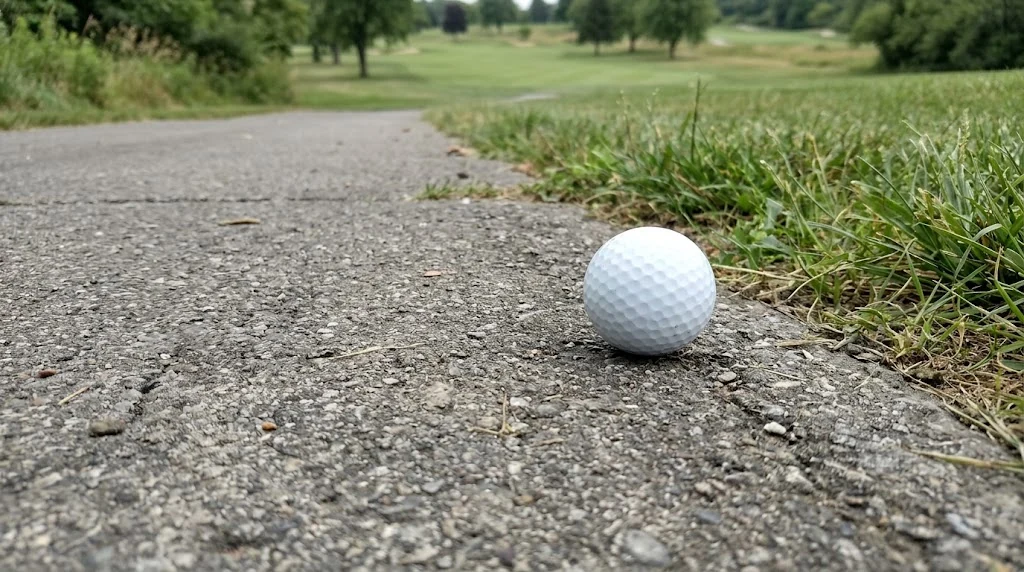
When an eligible cart path interferes with a ball in the general area, you can normally take free relief using the nearest point of complete relief and a one-club-length relief area. You do not simply choose whichever side of the path gives the better shot.
Check the path, the ball and the actual interference
A constructed cart path is commonly an immovable obstruction, but check the course's Local Rules. An integral object or boundary object does not automatically provide the same relief. A worn track is not necessarily the same thing as an artificially surfaced path.
Rule 16.1 covers interference with the ball's lie, intended stance or intended swing. A path merely lying on your line towards the hole does not normally qualify when the ball is in the general area. Relief is also restricted where playing the ball is clearly unreasonable for another reason, or the claimed interference arises only from an unreasonable choice of stroke.
This guide focuses on a ball in the general area. Bunkers, putting greens and penalty areas have different provisions. For the last of those, see our penalty-area explanation.
Find the point that removes all the path interference
The R&A Rule 16.1b explains the reference point and the one-club-length limit. Determine the nearest eligible spot in the general area, no nearer the hole than the original ball, where the path no longer interferes with the stroke you would have made from the original position.
Consider the club, stance and swing that the situation actually calls for. The reference point may be different for right- and left-handed players. Do not assume that a ball on the left half of a path must be dropped on its left side, or that relief always leads to fairway grass.
First assess the options without picking up the ball. The nearest point may be in rough or another unattractive position. In an ordinary eligible situation, taking relief is an option rather than a promise of a better lie. Mandatory relief conditions, such as a no-play zone, must be handled separately.
Use the reference point to establish the relief area
| Step | Check |
|---|---|
| 1. Establish eligibility | A qualifying condition interferes and the relevant Rule permits relief. |
| 2. Find complete relief | Identify the nearest allowed reference point, not the best-looking grass. |
| 3. Measure the area | One club-length from the reference point, no nearer the hole, in the general area. |
| 4. Check the final position | The ball must finish in the relief area and all path interference must be removed. |
Complete relief matters. A ball resting on grass is not enough if your intended stance still has a foot on the same path. Conversely, you do not gain extra distance simply because the full one-club-length circle would cross the path or run nearer the hole; the restrictions trim the usable area.
Drop correctly rather than placing the ball
Rule 14.3 supplies the dropping procedure. Let the ball fall straight down from knee height without throwing or spinning it. It must first touch and then finish in the required relief area for this ordinary path-relief procedure.
If a correctly dropped ball finishes outside that area, follow the Rule's re-drop procedure. If the second correct drop also finishes outside, the required placement procedure applies. Do not count a wrongly performed drop as one of those two correct drops.
Our preferred-lies guide explains a separate placing procedure. Permission to place under a Local Rule elsewhere does not turn every cart-path relief situation into a placement.
A short example: the nice side is not necessarily the nearest side
Imagine a right-handed player whose ball rests near one edge of a path. Fairway grass is visible on the other side, but a nearer point that removes the path from the ball, stance and swing lies in light rough. The fairway's better view of the green does not make it the correct reference point.
Before lifting, ask someone familiar with the Rules to help establish the geometry if necessary. Explain the intended shot and show the original ball position. If you have already dropped, tell the official what you did and whether you have made a stroke.
Be considerate while resolving it: stand safely, keep equipment clear of traffic and communicate with the group. Our etiquette guide covers those habits, while the course-transport guide covers using paths and carts during the rest of the round.