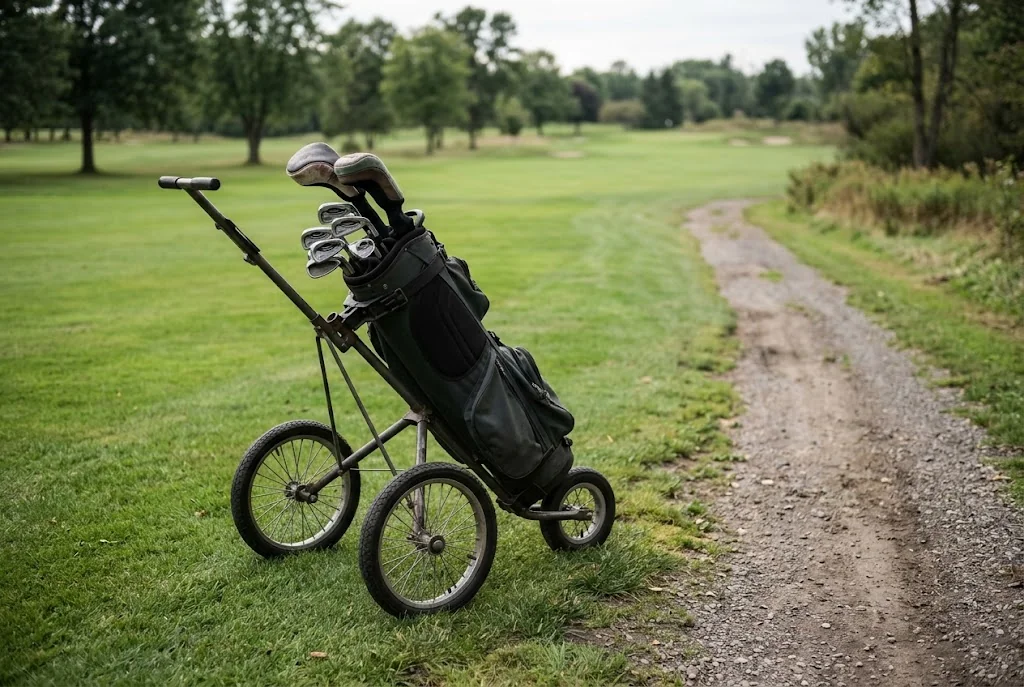
Carrying a golf bag, using a trolley and riding in a buggy involve different equipment and booking decisions. Start with what the course permits, then consider the route, the equipment available and what suits your visit. Hiring a buggy does not automatically mean you can drive directly to every ball, and walking does not require carrying your clubs.
First, clarify the local terminology
A push or pull trolley carries the golf bag while the player walks. An electric trolley helps move the bag, while the golfer usually still walks. A ride-on buggy or golf cart carries people as well as equipment.
The word cart can be ambiguous across markets. When reserving equipment, describe what you need rather than relying on one word. Ask whether the booking is for a bag trolley or a ride-on vehicle, and whether equipment is shared.
Your golf booking and the equipment reservation may be separate. A tee-time confirmation does not necessarily reserve a trolley, buggy, club set or caddie.
What should you consider before carrying?
Look at the bag you actually intend to bring and the route you have booked. A loaded travel or tour-style bag is a different practical choice from a lighter bag prepared for a walking round.
Check that straps, pockets and the stand work before arriving. Keep only the items needed for the visit while retaining the supplies the course recommends. Distribute equipment so that frequently used items are easy to reach.
This is an equipment decision, not a fitness test. If carrying does not suit you, ask about alternatives before the round. Do not rely on a photograph to establish the gradients or the distance between holes.
A trolley lets you walk without carrying the bag
Confirm that the course permits your type of trolley under the current conditions. Wet-weather or seasonal restrictions may change what is allowed. Ask whether hire equipment must be reserved and whether it suits the bag you plan to use.
Check the bag's fastening and the trolley's controls before leaving the starting area. If you bring an electric model, follow its manufacturer's operating, charging and transport instructions. Do not assume a course will supply a compatible charger or battery.
A trolley still needs a permitted route. Keep it away from areas the venue restricts and park where it will not obstruct play. Use the staff introduction to understand any local instructions.
Reserve a buggy on the venue's actual terms
Ask about availability, permitted users, any eligibility requirements, seating and sharing arrangements. Confirm whether restrictions apply to the whole course or particular areas and what happens if conditions prevent use.
Courses can offer very different arrangements. For example, St. Andrews Golf Club in Trinidad describes its own walking, caddie and limited buggy arrangements. That is a venue-specific example, not a booking policy for St Andrews in Scotland or for another course with a similar name.
Follow the operator's safety instructions and use only permitted routes. If access is restricted to paths, plan how to reach the ball with the appropriate clubs. Do not enter closed or sensitive areas simply to shorten the journey.
Use a short booking checklist
| Question | Why to settle it early |
|---|---|
| What is permitted today? | Conditions can change access for trolleys and vehicles. |
| What must be reserved? | The tee time and equipment may be separate bookings. |
| Which route applies? | Paths, restricted areas and between-hole distances matter. |
| What is included? | Clarifies sharing, hire duration and equipment supplied. |
| What if conditions change? | Allows a practical alternative to be agreed. |
Keep the answers with your booking details. Ask specific access questions directly to the venue where needed, sharing only the information required to arrange the visit.
Make any method work with the group
The R&A's pace-of-play guidance includes movement between strokes and to the next tee. The fastest-looking equipment does not remove the need to be organised and ready.
Position your bag or vehicle considerately, collect the clubs you need and avoid leaving equipment where someone may strike it. Listen to staff if routes or starting arrangements change. Our etiquette guide covers the wider course-care and safety questions.
For the rest of your preparation, use the first-round checklist and round-duration guide. Choose the permitted arrangement that fits the actual course and your visit, then arrive knowing how it works.