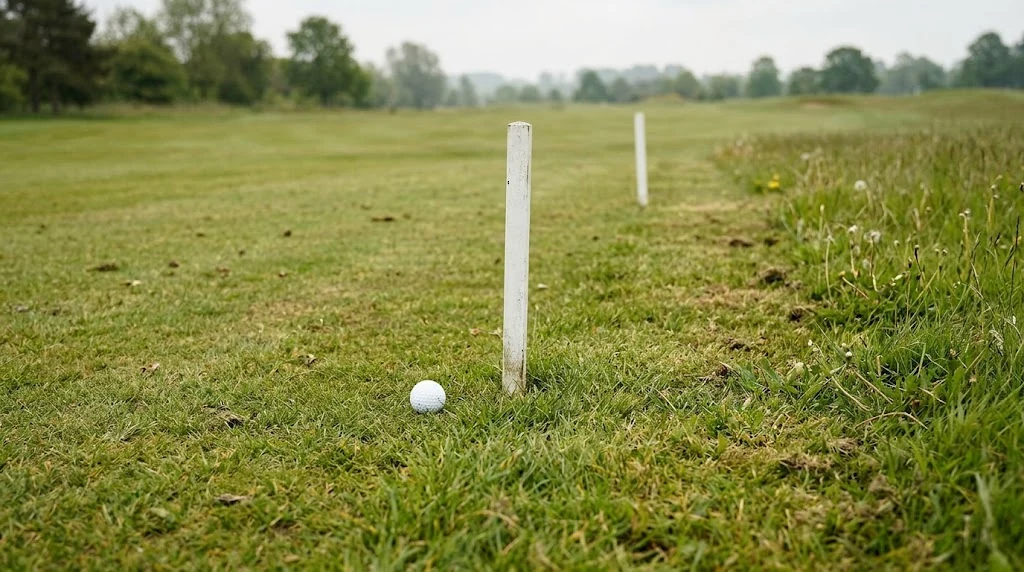
A ball lost outside a penalty area and a ball out of bounds normally lead to the same result: add one penalty stroke and play again from the previous spot. They reach that result for different reasons. A lost ball has not been found within the permitted search time; an out-of-bounds ball is entirely beyond the course boundary.
First decide what happened to the ball
The first question is not where you would like to drop. It is whether the ball is still on the course, lost outside a penalty area, out of bounds, or known or virtually certain to be in a penalty area. Those distinctions determine the available procedure.
The USGA's lost-ball and out-of-bounds topic hub brings together the relevant guidance. For the separate red and yellow options, use our penalty-area guide. Seeing a shot travel towards water is not, by itself, enough to settle every missing-ball situation.
Before the round, check the course's boundary information and current Local Rules. A white stake, fence or painted line has a specific purpose; a path or change in grass length does not automatically mark out of bounds.
Lost and out of bounds mean different things
Under Rule 18.2, the search period is three minutes from when you or your caddie starts looking. It does not start simply because the shot left the club. A ball found in time may need prompt identification, for which the Rule allows a reasonable additional period.
A stationary ball is out of bounds only when all of it is outside the boundary edge. If part is inside or over that edge, it is in bounds. You may stand outside the course to play a ball that is in bounds. Ask for help with an uncertain boundary rather than judging only by which side of a stake the ball appears to occupy.
Use an identifying mark before starting. Our golf-ball markings guide explains why a printed number alone may not distinguish your ball from another player's.
Count the original stroke, the penalty and the replay
Stroke and distance includes both a penalty stroke and returning to where the previous stroke was made. The original stroke still counts.
| Fictional situation | Count before replay | Replay is |
|---|---|---|
| First tee shot is out of bounds | 1 stroke made + 1 penalty | Your third stroke, from the teeing area |
| Second shot from the fairway is lost outside a penalty area | 2 strokes made + 1 penalty | Your fourth stroke, from the previous fairway spot |
These examples assume no other penalties. They are counting illustrations, not permission to drop beside the point where the ball disappeared. The correct way to put a ball into play at the previous location depends on that location.
The two-stroke local alternative must actually be in force
Model Local Rule E-5 allows a Committee to provide an alternative to stroke and distance. When adopted, its two-penalty-stroke procedure uses specified ball and fairway reference points to define a relief area. It is not an unrestricted drop wherever a group finds convenient.
Check the actual notice and its diagram before using it. The model does not apply to a ball known or virtually certain to be in a penalty area or to an unplayable ball. If you have already played a provisional, you cannot use this alternative for the original ball. The model can instead apply to the provisional if that ball is itself lost or out of bounds. Do not assume this option exists at every course or competition.
Prepare for uncertainty before leaving the previous spot
A correctly announced provisional can save a return journey when the original might be out of bounds or lost outside a penalty area. Our provisional-ball guide explains that procedure and when the original must still be played.
For your next round, keep a spare marked ball accessible, watch the finish of each shot and note a useful landmark. If a ruling is unclear, give the referee or Committee the sequence: where the stroke was made, where the ball travelled, when searching started and whether another ball has been played. A clear account is more helpful than describing every difficult ball as “lost.”