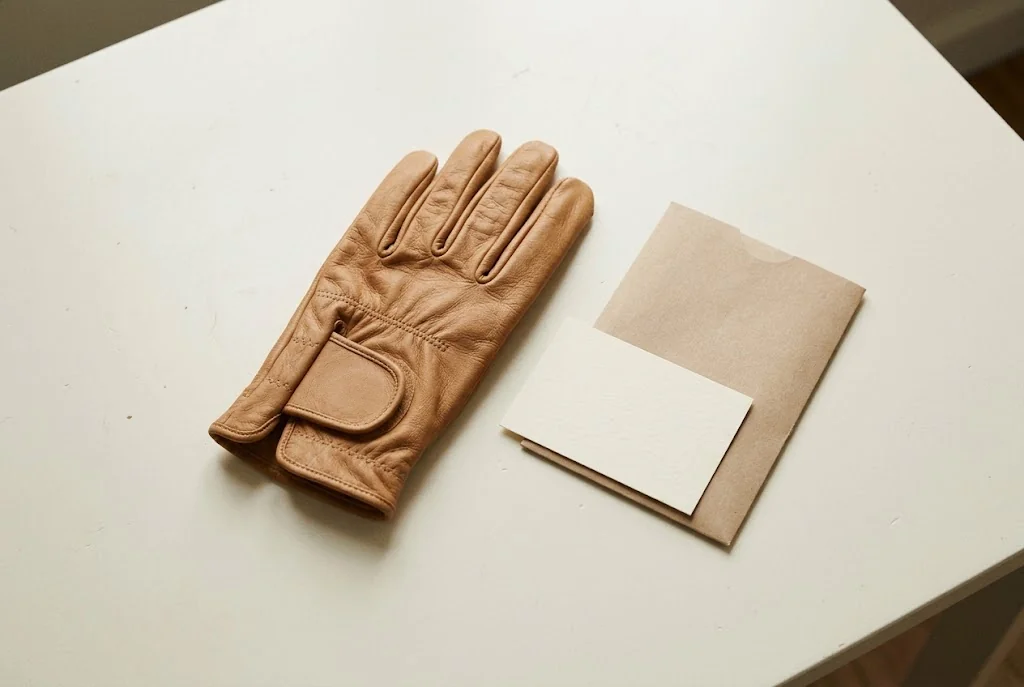
A golf glove care card should describe the care appropriate to the finished product, including its materials, print and trims. Agree the instructions before writing the short version, make the card readable and connect it to a maintained product guide. Do not copy washing or drying claims from another glove simply because its material name looks similar.
Begin with the finished construction
List the materials in the approved glove and identify its decoration, closure and other relevant components. A short description such as “leather glove” can hide a mixed construction. The care wording needs to suit the complete product.
Ask the product team and manufacturer which instructions are supported for that version. Keep unresolved questions visible during development. Washing method, products to avoid and drying arrangements should not be guessed by the designer laying out the package.
Our care guide provides general reader guidance. The brand's task here is to approve and maintain the instruction supplied with one identified product.
Settle the questions before compressing the wording
A useful working document can be longer than the eventual card. It should establish what a customer needs to do after use, how the glove should be allowed to dry, how to store it and what cleaning is appropriate to the finished construction.
Write down any limitations that materially change the instruction. If a cleaning method has not been agreed for a printed finish, do not silently treat advice for a plain sample as approval for the printed one.
Avoid temperature limits, machine-wash claims or chemical recommendations without supporting product information. “Easy care” is not a method, and a care card should not introduce a performance claim the product brief never approved.
Give the short card a clear hierarchy
Decide which actions the customer needs immediately and which explanation belongs in the longer guide. Start with the actions that prevent the most likely confusion for your particular product.
| Card element | What to prepare |
|---|---|
| Product identity | The range or construction the instruction applies to. |
| After-use care | A short action approved for the finished glove. |
| Drying and storage | Clear instructions, with relevant limitations. |
| Cleaning | The agreed method or a clear route to the correct guidance. |
| Further help | A stable guide address and the brand's support route. |
This is a content framework, not a universal instruction for every glove. Replace each field with the wording approved for your construction. Do not print the internal questions as though they were finished customer advice.
Write for the moment the customer needs help
Use familiar verbs and short sentences. Explain what to do rather than relying on broad phrases such as “maintain appropriately”. Read the draft without the specification beside it: can someone identify the next action?
Keep marketing language separate from instructions. A promise of lasting softness or improved grip should not appear merely because there is space on the reverse of the card. Use that space for a useful instruction or support detail.
For translations, work from the approved source and review the meaning in context. Our localisation checklist explains how to keep materials and care wording consistent between languages. Translation does not resolve an instruction that was unclear in the original.
Proof the physical card and its online destination
Review a print-size proof under ordinary reading conditions. Check contrast, type size, folds and where the card will sit in the packaging. A readable desktop mock-up can become cramped when reduced to the actual insert.
If you use a QR code, test the printed proof with ordinary phones and provide a readable address where practical. Make the destination a maintained care page rather than a temporary promotion. The customer may need the instruction long after the launch campaign ends.
Check the whole journey: package, care card, product page and help page. The product-page checklist helps keep those statements aligned. Do not send a customer through a code to contradictory guidance.
Give the instruction a version and an owner
Connect the card artwork to the product specification and approved sample. Record who checked the technical wording, who approved the language and which file is ready for print.
If the material, print or construction changes, review whether the instructions must change too. Identify which stock uses the earlier card and how your online guide will distinguish versions if needed. Avoid updating a general web page so that it no longer explains the product a customer already owns.
Texpak can discuss glove construction, packaging and the artwork included in a manufacturing brief. Send your product and packaging requirements so care-card decisions can be agreed alongside development. Keep the final wording tied to the actual glove rather than adding it as an unreviewed printing extra.