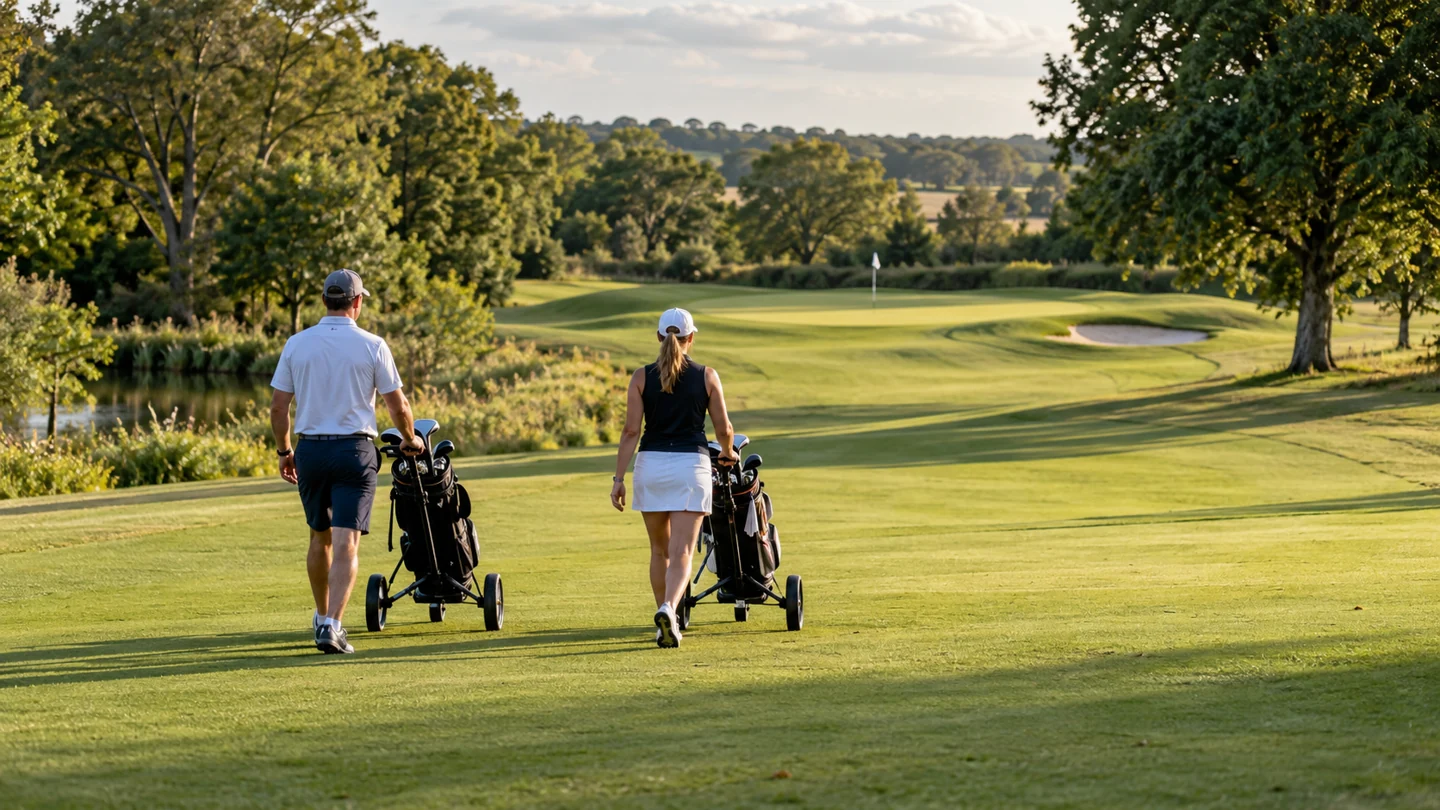
A useful starting budget is about two hours for nine holes and four hours for eighteen, plus time for arrival, preparation and anything you plan afterwards. Those are planning estimates, not guaranteed finishing times. Your course's own expectation is more useful than a universal number.
A short, quiet course with two players can feel very different from a busy eighteen-hole layout with four players, long walks between holes and an event taking place ahead.
Plan the visit as well as the round
| Part of the visit | Nine-hole outing | Eighteen-hole outing |
|---|---|---|
| Playing time to budget initially | Around 1.5–2.5 hours | Around 3.5–5 hours |
| Arrival and preparation | Add the time your venue recommends | Add the time your venue recommends |
| Warm-up or lesson | Add separately if booked | Add separately if booked |
| Food, changing or social time | Add according to your plans | Add according to your plans |
These are broad suggested budgeting ranges, not survey averages or a course policy. Rounds can fall outside them. If you must leave at a fixed time, ask the golf shop about the specific course, group and tee time before booking.
Why eighteen holes do not always take twice as long as nine
The two nines may have different lengths, terrain and distances between greens and tees. The course might also have a queue at a particular hole or a scheduled starting arrangement that affects the second half.
The same golfer can therefore take different amounts of time on different days without changing their normal walking pace. Weather, ground conditions and traffic influence the experience as well.
Nine holes remain a useful option when your available time is limited. Confirm the actual route and expected return point instead of assuming you can leave an eighteen-hole round halfway through wherever convenient.
Group size changes how the day works
More players usually means more separate decisions and shots, but the number of people is only one factor. A well-organised group can stay in position; a smaller group can still be delayed by congestion ahead.
Ask whether you will be paired with other golfers. A booking made for one person does not necessarily mean you will play alone.
For a first visit, a group with someone who understands the venue can make check-in, tee selection and scoring easier. See our first-round checklist for preparation.
Does a cart make golf quicker?
It can reduce some walking, but it does not remove the time spent waiting, choosing shots or moving between different players' balls. Cart-path restrictions, terrain and shared-cart arrangements also matter.
Book a cart because it suits the visit and your needs, then ask the venue about expected round time. Do not assume it will turn a four-hour booking into a two-hour outing.
Keep moving without rushing your swing
Useful time savings often happen between shots. Organise your accessories before starting, know where your ball is likely to be, and prepare when it is safe without distracting another player.
The R&A's pace guidance encourages prompt play. In stroke play, safe and responsible ready golf can help, but it does not mean walking into another player's hitting area or abandoning match-play order without understanding the Rules.
Our etiquette guide explains practical on-course habits. A comfortable pace should never depend on ignoring safety.
Three questions that give a better answer
Ask the course: “What round time do you expect for this tee time?”, “Are there events or restrictions that could affect play?” and “How early should we arrive?”
Then give your own group a clear plan. If lunch, a lesson or a meeting follows, include a buffer rather than placing the next commitment at the earliest possible finishing time.