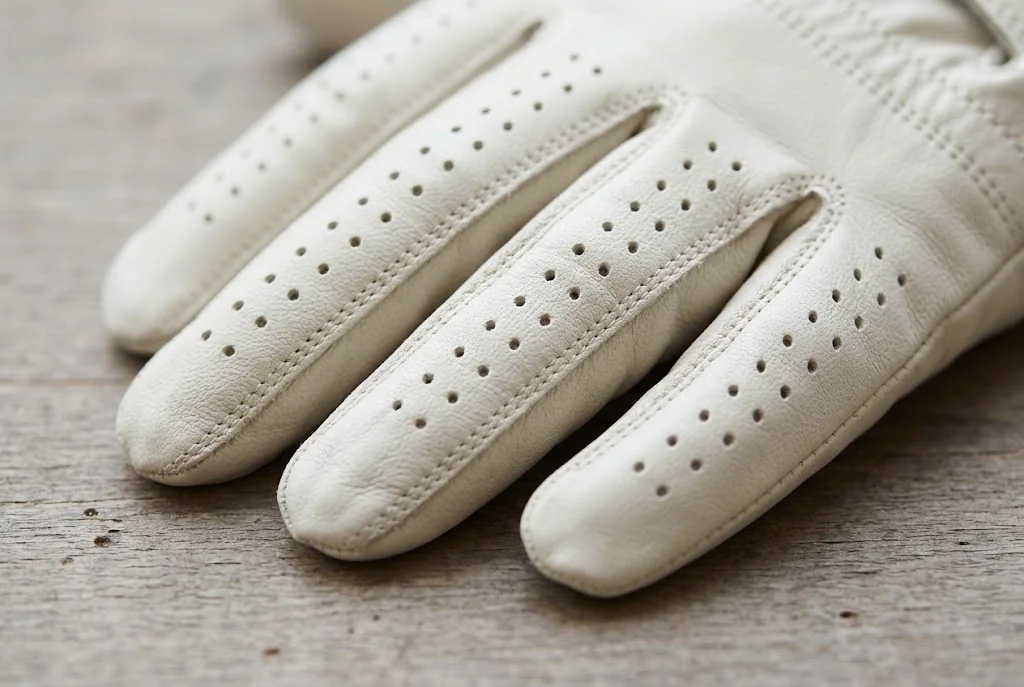
A useful golf glove perforation brief identifies the panels, layout and appearance to review in the physical sample. Do not rely on the word “breathable” or assume one photograph defines every hole. Keep perforations separate from stretch inserts and material selection, and agree the finished construction before making performance claims.
Mark the layout on the correct views
Provide back, palm and thumb-side views of the proposed glove. Identify the areas intended to carry perforations and any areas that should remain plain. Show the relevant fingers clearly instead of marking a broad shaded region and leaving the detail to interpretation.
Use a current drawing or approved reference. A small photograph can obscure whether an apparent dot is a hole, print or a shadow. If the purpose is to retain the layout of an existing approved glove, identify that sample and explain any intended change.
Our tech-pack checklist covers the complete brief. Perforation drawings are one part of it, alongside materials, fit, seams, closure and artwork.
Make the appearance measurable without inventing a standard
Discuss hole appearance, spacing and the extent of the pattern with the manufacturer. Where dimensions are agreed, label the units and the reference points used. Confirm how the layout continues across different sizes rather than assuming a single drawing scales automatically.
Do not borrow an arbitrary hole diameter or spacing from a generic guide. The right specification belongs to the actual material, panel and construction being developed. This article does not supply a universal manufacturing tolerance.
A physical reference can communicate a look more effectively than a phrase such as “lots of small holes”. Use the sample review to turn that visual direction into an agreed product, keeping unresolved dimensions visible until confirmed.
Review perforations with the surrounding construction
Look at the relationship between the layout, panel edges, seams, folds and decoration. A drawing that looks balanced in a flat view may sit differently when the glove is worn and fastened.
Discuss changes near a seam or a logo before approving the artwork. Do not assume a printed mark can simply cover an uncertain area of the construction. Keep material and design decisions connected so different people are not approving incompatible versions.
Perforations and stretch inserts are separate features. An insert can have a different stretch behaviour from leather, while the perforation layout describes openings in a panel. Our hybrid-construction guide explains the material choices; it is not a substitute for a marked layout.
Use a focused sample-review checklist
| Review point | Question for the sample |
|---|---|
| Location | Are the intended panels and fingers treated as drawn? |
| Appearance | Does the pattern match the agreed reference? |
| Construction | How does it sit beside seams, edges and decoration? |
| Worn condition | Does the finished glove look and feel appropriate when fastened? |
| Range consistency | What has been agreed for the other sizes and wearing hands? |
Photograph the whole glove as well as useful details. Mark any requested revision on a copy and retain the original image. Identify the sample version, size and wearing hand so a pattern change is not applied to the wrong reference.
If you need to assess the glove during play, use a documented wear trial. Keep comfort observations separate from claims about measured airflow, drying speed or strength.
Do not turn a visible feature into a proven outcome
Showing a perforated back is a product description. Promising a particular reduction in sweating or a numerical improvement in ventilation requires evidence for the finished construction and the exact claim.
Material, fit, conditions and the player all matter to the experience. A photo cannot establish that a glove will keep every hand dry. Our sweaty-hands guide discusses the buying decision without treating one feature as a universal solution.
Texpak's confirmed checks include leather tensile and tear strength, printing and workmanship. No specific airflow test or perforation-performance threshold is announced here. If your brand needs additional testing or a defined claim, raise it during development and agree the evidence required.
Keep the approved layout with the master sample
After revision, identify the accepted drawing and physical sample together. Update the specification rather than leaving the final decision in a separate message. If the layout later changes, review the resulting sample again.
Texpak retains approved master samples for future comparisons. Share your construction views and perforation references with the intended material, fit range and artwork so the team can discuss a coherent glove brief. Precise instructions and physical approval are more useful than a broad ventilation promise.