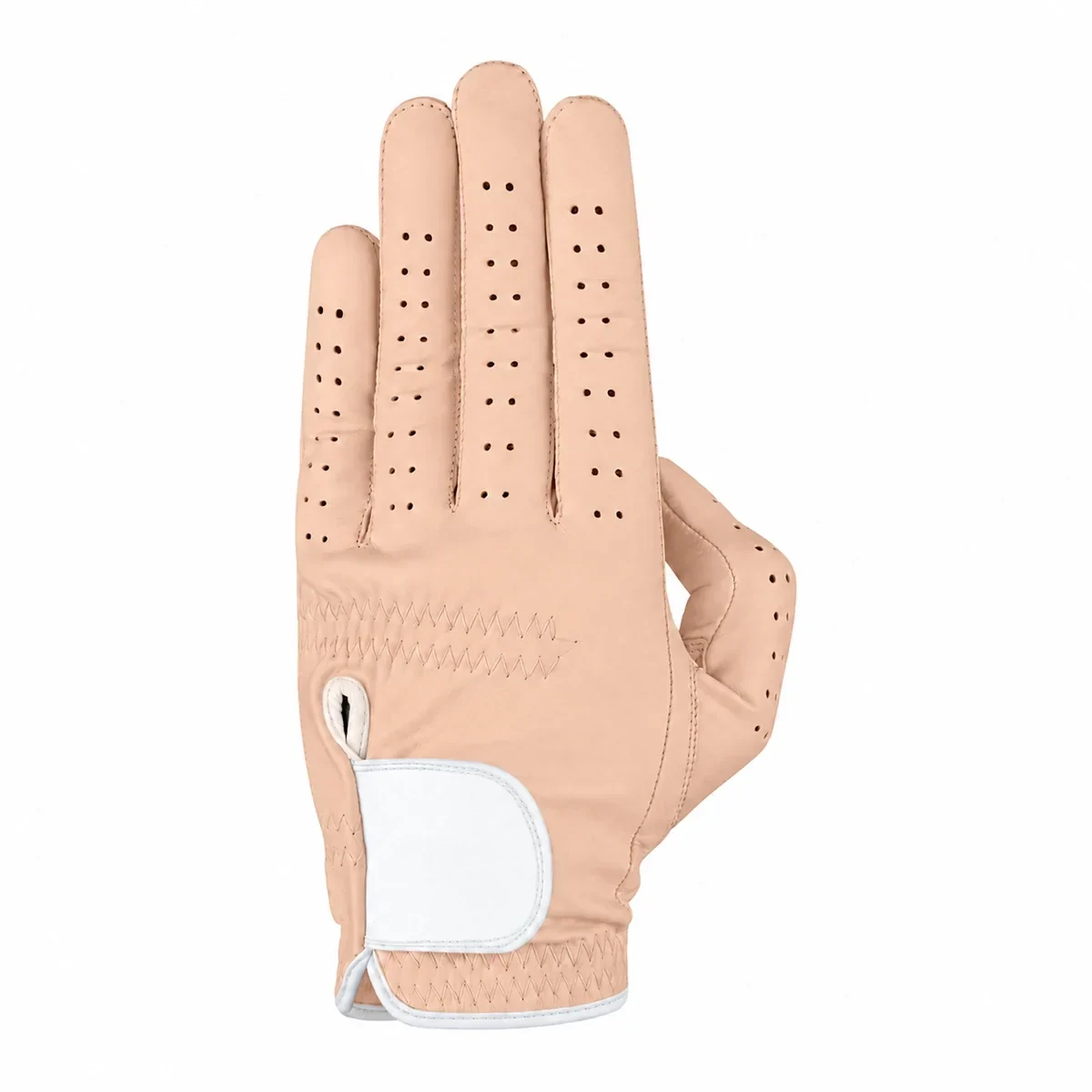
A club-branded golf glove needs to work as a piece of equipment as well as a reminder of the place it came from. Before choosing a crest position or colour, decide who will buy it, which fit and material they need, and how the shop will keep the useful sizes available. Those decisions turn a branded sample into a range the retail team can actually manage.
Give the glove a clear place in the shop
Start with the job the product should do. A replacement glove for a member about to tee off, a premium club souvenir and a distinctive resort collection can each justify a different brief. Trying to serve every purpose with the same launch can make the choice of materials, presentation and quantities harder than it needs to be.
For a first range, write one sentence describing the intended buyer and one describing why that person would choose your glove. A fictional example might be: “A soft leather glove for regular players who want the club crest on equipment they use every week.” That gives the buyer and manufacturer something more useful to discuss than “a premium glove with our logo”.
A continuing shop range also has a different ordering problem from a one-day giveaway. Event gifts start with a guest list and an arrival deadline; a shop must also consider repeat purchases and gaps in stock. Use our corporate golf-day guide if the project is primarily for an outing.
Plan around your own members and visitors
Ask the retail team what golfers already request. Which materials do customers ask to feel? Which sizes are regularly unavailable? Do visitors want a usable replacement, a gift or a club-branded keepsake? Record actual requests rather than assuming a visiting golfer buys in the same way as a local member.
The same approach works for a club in Ireland, a resort in Portugal, a North American golf shop or an Australian destination. The audience changes the brief; the country name alone does not provide a reliable size mix or a forecast of sales. For a shop serving several nationalities, collect fit feedback from a suitable spread of wearers instead of making one person's hand the reference for everyone.
Keep the first order understandable. A small number of well-defined styles is easier to explain and review than several almost identical gloves whose differences exist only in the buyer's notes. Decide what each option adds before committing budget to another colour or construction.
Choose a material you can explain at the counter
At Texpak, we manufacture with Cabretta leather, synthetic leather and synthetic suede. In our manufacturing experience, Cabretta is the option we favour when a soft, premium leather feel is the main priority. The best choice for a particular shop still depends on its customer, product specification and budget.
Review the complete glove, including any panels made from a different material. A customer should be able to understand what they are holding without being given an unsupported promise about weather resistance or wear life. Our Cabretta and synthetic comparison explains the material discussion in more detail.
Browse the classic white Cabretta and black and green synthetic style as starting references for a manufacturing conversation. A listed sample style does not settle the specification, branding or commercial terms for your own range.
Approve the crest on a physical glove
Confirm who can authorise use of the club, resort or associated sponsor marks. Supply the correct artwork and identify the intended placement and dimensions. A logo that reads clearly on a sign may need a more careful treatment on a glove closure.
Texpak prefers PDF artwork or a tech pack with exact logo dimensions. PNG or JPEG files can also be assessed, with dimensions confirmed during development. We can help develop the brief when technical files are incomplete; the extra clarification needs to be allowed for in the sample process.
Check the sample with the closure fastened as well as laid flat. Review the crest's readability, position and relationship to the seams. Keep the final artwork version with the approved product reference, so a later reorder does not quietly return to an older mark. Our artwork-approval checklist covers those checks.
Separate the size assortment from the display
A display sample helps someone notice the product. It does not establish which sizes or wearing hands the shop needs to sell. Prepare an order breakdown showing design, colour, fit range, size, worn hand and the number of individual gloves for each line.
Use explicit descriptions such as “worn on the left hand”. Keep that wording consistent on the order, shelf label and customer information. A golfer's playing side and the hand wearing a glove are different pieces of information.
Texpak's general MOQ is 250 individual gloves per design and colour, with smaller projects considered case by case. That is not 250 pairs or a promise that every small shop order will be accepted. Discuss the actual assortment and project with us; our first-order assortment guide explains how to organise the breakdown.
Make the approved sample useful to the retail team
Give staff a short product record: materials, available fit and hand options, the approved care guidance and the shop's own customer-service process. If you want a try-on sample, agree how it will be identified and kept separate from sale stock. Do not assume a particular tester unit or display fixture is included in a manufacturing quote.
Review packaging at its actual size with the correct glove inside. The style, size and wearing hand should remain easy to find. If your stock system has label or barcode requirements, provide them before packaging approval. Our packaging guide helps connect those choices.
Keep product cost, shipping, packaging and your own retail pricing decisions distinct. A manufacturer's quotation is not evidence of a guaranteed retail margin or sales rate.
Decide what will trigger the next order
Track sales by the actual variant, together with requests you could not fulfil. A range can appear to be selling slowly while a useful size has already sold out. Review that information alongside the next required delivery date, rather than waiting until every shelf space is empty.
Texpak retains approved master samples for production comparisons. Identify the same reference when discussing a repeat order, and flag any change to colour, materials, fit, artwork or packaging. A changed specification needs new sample approval; our reorder checklist explains the process.
A practical brief for your club or resort
| Decision | What to share |
|---|---|
| Customer and purpose | Member replacement, visitor retail, souvenir collection or another defined role. |
| Product direction | Materials, reference style, intended feel and fit ranges. |
| Branding | Approved crest files, dimensions, colour references and authorised decision-maker. |
| Order and presentation | Estimated quantities by size and worn hand, packaging and shop handling requirements. |
| Delivery | Destination and the date stock must be received and checked. |
Discuss your club or resort range with Texpak. We manufacture in Sialkot, Pakistan, with our own leather-processing tannery and in-house cutting and stitching. Bring the brief you have; we can discuss the choices still needing development.
Sample making, revisions and prototyping are free; customers pay sample shipping. The physical sample gives your team a product to assess before agreeing the bulk specification. Explore our OEM and private-label service for the wider manufacturing process.